
Published
15 minute read
Body contouring after weight loss, Tampa patients usually search for, usually starts with one honest thought: “I did the hard part, so why doesn’t my body look finished?” The answer is simple, even if it feels frustrating. Fat loss and skin tightening are not the same thing.
When weight drops quickly or dramatically, the skin and support tissues often cannot shrink all the way back. That can leave hanging skin, stubborn folds, a deflated shape, skin irritation, and a body that feels smaller but still not fully comfortable.
This is especially common after bariatric surgery, major lifestyle change, pregnancy, or rapid weight loss linked to GLP-1 medications such as Ozempic or Wegovy. Patients often come in saying they are proud of the number on the scale but still avoid fitted clothes, swimsuits, sleeveless tops, or intimacy because their skin does not match the work they put in. That emotional gap is real, and it deserves a practical plan.
At Artisan Aesthetics Plastic Surgery, the body contouring conversation is not just about removing more fat. It is about figuring out where the real problem lives. Is it lower abdominal skin? Muscle separation? Arm laxity? Thin skin with some leftover fat? Neck looseness after weight loss? Once you identify the real issue, the right surgery becomes much easier to understand. You can start by reviewing body contouring surgery in Tampa, a tummy tuck in Tampa, Renuvion skin tightening, and upper arm lift options.
When the body stretches over time, the skin’s elastic fibers and support structures can weaken. Some people bounce back better than others, but large or rapid weight changes make recoil harder. Age, genetics, smoking history, pregnancy, sun exposure, and the amount of weight lost all affect how well the skin snaps back.
The American Society of Plastic Surgeons explains that body contouring after major weight loss addresses excess sagging skin and fat that remain after the body becomes smaller. That is an important point. The issue is often not just “extra skin.” It can be a combination of thin hanging skin, pockets of fat, and weakened support tissue. You can read ASPS’s overview here: Body Contouring. Patients often notice the same pattern:
No. This is one of the biggest misunderstandings in post-weight-loss surgery.
Liposuction removes fat. It is excellent when the skin is still elastic enough to contract, and the main issue is fullness rather than hanging skin. It is not a good substitute for skin excision when the problem is loose, draping tissue.
That is why some patients feel disappointed after liposuction elsewhere. The fat may be smaller, but the skin still hangs. In fact, if the wrong patient gets liposuction alone, the skin laxity can look more obvious afterward.
The ASPS 2024 statistics continue to show that liposuction is the most popular cosmetic surgery procedure in the United States. That popularity makes sense because it works well for the right candidate. But popularity should never replace diagnosis. A post-weight-loss body does not always need “more lipo.” It may need skin removal, tightening, muscle repair, or a staged combination. For context, here is the ASPS chart showing liposuction at the top in 2024: Top five cosmetic surgery procedures.
A tummy tuck is often the central procedure after major weight loss or pregnancy. It can address:
This is why the tummy tuck is often a better answer than liposuction for patients whose main complaint is loose belly skin. If your lower abdomen folds, rubs, or hangs, skin removal may be the actual fix.
Liposuction still plays an important role. After weight loss, some people are left with localized fat in the flanks, back, arms, bra line, or under the chin. If the skin quality is still decent, liposuction can help refine those areas. It is often used as part of a bigger contouring plan, not as the whole plan.
Renuvion can be helpful when skin looseness is present but not severe enough to require a larger skin excision. It is usually best for patients who want improvement in mild to moderate laxity and who understand that it does not replace a tummy tuck or arm lift when there is significant hanging skin. In the right patient, it can improve definition and skin contraction in a less invasive way than larger excisional surgery.
One of the most frustrating post-weight-loss changes is the arm area. Patients say their arms still wave after the rest of the body has changed. When skin hangs from the upper arm, exercise can build muscle underneath, but it usually will not remove the excess skin itself. That is where a brachioplasty, or arm lift, becomes worth discussing.
The truth is that post-weight-loss bodies rarely fit into one neat procedure box. A patient may need:
The best plan is the one that treats the actual complaint instead of trying to force every patient into the same operation.
A good candidate usually has:
Enough loose skin or contour irregularity that surgery would meaningfully improve comfort and shape.
Weight stability matters more than many people think. If you are still losing quickly, the body may keep changing after surgery. That can affect the result. In many cases, surgeons prefer to evaluate body contouring after a period of stable weight, especially if the patient has recently started or increased a GLP-1 medication.
This is also where nuance matters. The “best time” is not always the same for every patient. Someone who lost 25 pounds on a GLP-1 and mainly has lower-belly laxity may be in a different category than someone who lost 120 pounds after bariatric surgery and has skin issues in several areas.
What About GLP-1 Weight Loss and Ozempic Loose Skin?
This topic is growing fast because more patients are losing weight with medications and then seeing skin laxity in the face, neck, arms, and abdomen. Rapid loss changes volume quickly. Skin does not always keep up. If that sounds familiar, Artisan already has a helpful page on GLP-1 loose skin solutions in Tampa.
The key point is this: body contouring after Ozempic is not a separate category of surgery. It is still about anatomy. The surgeon looks at your skin, fat, muscle, health, and stability, then matches you with the right option. The treatment is not based on the brand name of your medication. It is based on what changed in your body.
This simple framework helps many patients.
Patients often try to self-diagnose using before-and-after photos online. That can help with general education, but it can also create confusion because two people with similar “weights” can have completely different skin quality and tissue behavior. The better approach is to ask, “What is the main thing I want fixed?” Then let the physical exam confirm whether that complaint is skin, fat, muscle, or some mix of all three.
After major weight loss, it is natural to want every frustrating area corrected at once. But bigger is not always better in one stage. A staged plan may be recommended because it can:
Patients sometimes fear that a staged plan means the surgeon is holding back. In reality, it often reflects better judgment. Safe surgery is not about how many areas can be listed in one quote. It is about what can be done well, safely, and predictably.
Recovery depends on the procedure mix, but several themes are common.
Early Recovery
Swelling, soreness, tightness, and reduced mobility are normal. Compression garments may be part of the plan. Short, frequent walks are often encouraged early to support circulation. You will need help if your surgery is more extensive.
The First Few Weeks
This is when patience matters. The body can feel tight and swollen, especially after a tummy tuck. Arms may feel restricted after brachioplasty. Drain care may be part of recovery for some procedures. You may look better in clothing before you feel fully normal in motion, and that is okay.
Scar Management
Post-weight-loss contouring often creates longer scars than patients want, but that tradeoff is part of the conversation. The question is not whether a scar exists. The question is whether the contour improvement is worth it to you. For many patients, it is. The scar usually lies in a place that can be hidden by bras, underwear, swimwear, or natural positioning, depending on the procedure.
Long-term Settling
Final results do not arrive all at once. Swelling fades in layers. Tightness softens. Scars mature. Your brain also takes time to catch up with your new outline. Some patients feel surprisingly emotional after finally seeing skin addressed after years of effort. That response is normal, too.
Post-weight-loss contouring is not simple body “sculpting.” It requires judgment about tissues, scar placement, staging, safety, and proportion. Look for:
The right surgeon helps you prioritize. They do not overwhelm you with every possible procedure at once.
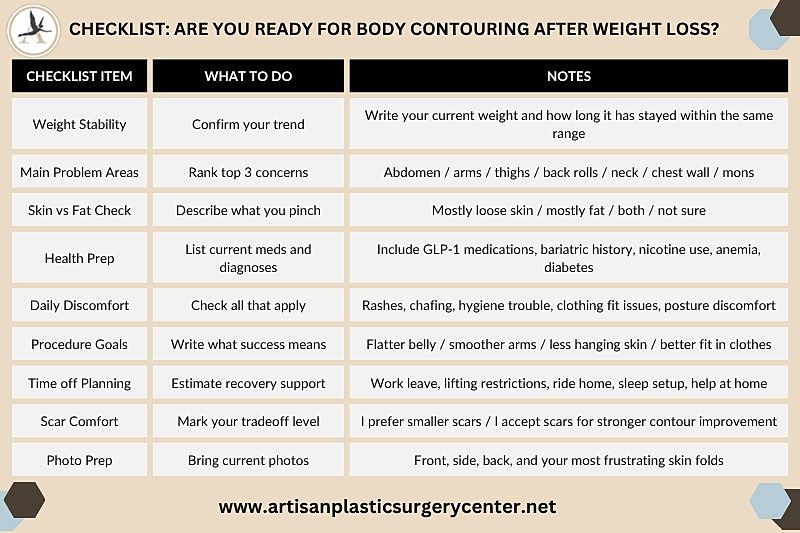
There is no single number that fits everyone. What matters most is that your weight is stable and your plan is sustainable. Many surgeons prefer a plateau rather than surgery in the middle of rapid weight loss. A consultation should focus on stability, nutrition, health markers, and which areas bother you most.
Not when loose skin is the main problem. Liposuction removes fat, not large amounts of stretched or hanging skin. In the wrong patient, lipo alone can make skin laxity more noticeable. That is why post-weight-loss patients often need a tummy tuck, arm lift, or another excisional procedure instead of liposuction alone.
For many patients, a tummy tuck is the most effective option because it can remove extra lower-abdominal skin and address muscle laxity at the same time. The right answer still depends on your exam. If the issue is mostly fullness and your skin quality is decent, liposuction or another option may play a role.
Usually not when there is significant hanging skin. Renuvion can be useful for mild to moderate laxity, but it is not a substitute for skin removal in patients with a true skin apron or major abdominal looseness. It works best when the surgeon matches it to the right level of laxity.
Medication planning should be discussed with your surgeon and prescribing clinician because timing, appetite effects, nutrition, and anesthesia planning can matter. The bigger body contouring question is whether your weight is stable and whether your nutrition supports healing well.
Yes, scars are part of the tradeoff with skin-removal surgery. The goal is to place them strategically and help them heal as well as possible. Most patients accept scars because the contour improvement, comfort, and clothing fit are worth it. Scar quality also improves over time with proper care.
Sometimes yes, but the decision depends on your health, operative time, recovery support, and the overall scope of surgery. In some patients, a staged plan is safer and smarter. The goal is not to do the most in one day. The goal is to do the right amount well.
Recovery varies by procedure. A tummy tuck usually involves more downtime than small-area liposuction or limited skin tightening. If you are combining procedures, expect a more involved healing period. Most patients improve in phases, with early soreness followed by gradual settling and longer scar maturation.
Yes. In fact, many of the classic body contouring cases involve patients who lost a significant amount of weight after bariatric surgery and are left with loose skin in the abdomen, arms, chest wall, thighs, or back. The right plan depends on where your excess skin remains and how stable your weight is.
Common areas include the abdomen, flanks, upper arms, thighs, chest wall, back rolls, neck, and under-chin region. Some patients mainly need one area addressed. Others need a staged full-body plan over time. Prioritization is often based on comfort, hygiene, clothing fit, and visual concern.
Yes. Surgery can improve shape and remove excess skin, but it does not replace healthy habits. The best long-term results usually come from pairing surgery with stable weight, regular movement, a realistic nutrition plan, and ongoing follow-up. Think of contouring as a finishing step, not a substitute for maintenance.
Ask which problem the surgeon believes is primary in each area, which procedures actually match that problem, whether you need staging, what scars to expect, what help you will need at home, how long you may be out of work, and what result is realistic for your body right now.
Losing weight changes your health, your confidence, and your future. It can also leave you with skin and contour issues that are impossible to solve with diet alone. That does not mean you failed. It means your body went through a major transformation.
If you are proud of your weight-loss progress but still frustrated by loose skin, bunching, hanging tissue, or shape imbalance, body contouring may be the next step that helps your outside finally match your effort. The best result comes from choosing the right tool for the real problem, not the trendiest term online. Schedule a complimentary consultation by calling (813) 971-2000. Also, view our body contouring before and after gallery.