
Published
12 minute read
If you’re googling “chin implant recovery in Tampa”, you’re likely in one of two places. You’re excited about finally having a sharper profile, or you’re nervous about swelling, numbness, and how “noticeable” healing will be. Both feelings are normal.
This guide breaks down three popular ways people improve the lower face and neck in Tampa:
You’ll get a practical recovery timeline, what to expect in the first week, and how to decide which option matches your anatomy.
A chin implant is designed to add structure and balance. It is often the most reliable option when you have a “weak chin” (microgenia) and you want a stronger profile.
At Artisan Aesthetics, Dr. Castor explains that chin augmentation is commonly done with a silicone implant placed through a small incision either inside the mouth or under the chin. The goal is a natural-looking improvement, not a “stuck-on” look. Best for:
Some people have a decent chin bone, but the area under the chin holds fat or looks “soft.” In these cases, removing fat can create a cleaner angle from chin to neck.
SmartLipo can be used for areas like the jawline and beneath the chin. Some patients also ask about VASER liposelection depending on candidacy. Best for:
Fillers can add shape, improve chin projection a bit, and create a cleaner jawline. It is a good “try it first” option for some people. But fillers are not a perfect substitute for bone structure, and they do not remove fat.
If you want to explore cosmetic dermal fillers. For safety education, the FDA has a clear overview of dermal fillers and risks. Best for:
Every surgeon’s protocol differs, but most people appreciate a timeline that helps them plan work, family, and social events.
This is when swelling starts. Your chin can feel tight or pressured. Some patients describe it like having a firm mouthguard or a “full” lower lip area.
Common Sensations:
Helpful Habits:
This is the “don’t judge your result yet” week. Swelling can make the implant look bigger than it will be long term. Numbness can still be present. Most patients feel presentable with basic care, but you may not want close-up photos. If you have a desk job, some people return within a week. If your work is physical, plan longer. Ask your surgeon what’s realistic for your role.
Swelling is noticeably improved. Most people feel “back in the world.” This is when you’ll start to get excited, because your profile looks more refined.
You may still notice:
The implant is settling. Your body is still forming the final tissue pocket. Overdoing activity too soon can increase swelling and discomfort.
Final contour continues to improve. Photos often look best after the early puffiness is gone and the tissue has fully settled.
If the incision is under the chin, the scar is usually small and hides in the natural crease. If it’s inside the mouth, the scar is not visible, but oral hygiene becomes extra important during early healing. Your surgeon will tell you what products to use and when. For general patient resources and post-op directions, this hub can be helpful.
Use this as a starting point. A consultation is what confirms it.
Choose a Chin Implant if:
Choose Chin/Neck Lipo if:
Choose Chin Fillers if:
Many patients actually do a combination. For example, a chin implant can improve projection while submental lipo refines the neck angle. Your anatomy decides what makes sense.
How long does chin implant swelling last?
Most swelling improves in 2–4 weeks, with refinement continuing for a few months.
Is numbness after a chin implant normal?
Temporary numbness can happen and often improves gradually as nerves recover.
Can I work the next day after chin augmentation?
Many people prefer a few days of rest. Your comfort and job type matter.
Will a chin implant look too big at first?
It can. Early swelling can make the result look stronger than the final outcome.
Does chin/neck lipo give the same result as a chin implant?
No. Lipo removes fat. An implant adds structure.
Can fillers replace a chin implant?
For mild cases, fillers may be enough. For a recessed chin, an implant is often more effective.
How long do jawline fillers last?
Duration varies by product and metabolism. Your provider will guide realistic timing.
Will I have a visible scar after chin implant surgery?
If the incision is under the chin, it is typically small and placed in a crease.
What’s the fastest way to improve a “double chin”?
It depends on whether the cause is fat, skin laxity, or bone position. A consult clarifies this quickly.
How do I know if I need chin lipo or neck lift instead?
If skin laxity is significant, tightening options may be needed in addition to fat removal.
Can SmartLipo treat the area beneath the chin?
Yes, SmartLipo can be used on the jawline and beneath the chin in appropriate candidates.
When should I call the office during recovery?
If swelling becomes severe on one side, pain suddenly spikes, or you have fever or concerning drainage, contact your team.
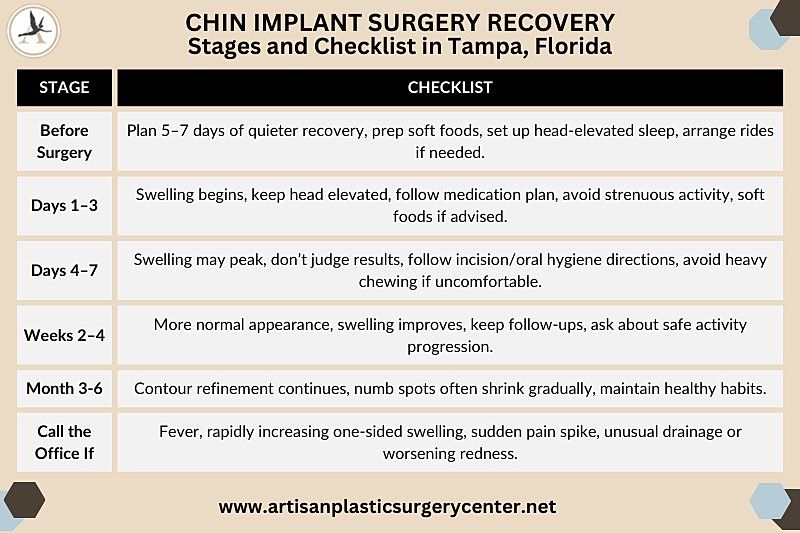
Most people do not describe chin implant recovery as “painful.” They describe it as “tight” and “weird”. That matters, because the feeling can be surprising even if you’re not truly in pain. Here are common real-life descriptions patients use:
The good news is that these sensations often improve steadily. The key is to protect your healing phase and not force big facial movements too early. Eating and speaking tips for Week 1. If your surgeon recommends soft foods, plan ahead. Think smoothies, yogurt, scrambled eggs, soups, and softer proteins. Avoid foods that require aggressive chewing if it increases discomfort.
Helpful Habits:
If your incision is intraoral, follow the office’s rinse instructions carefully. This is one of the best ways to reduce infection risk and keep healing smooth. If you ever feel unsure, use the Post-Op Directions hub as a reference point and then confirm with your care team.
Some people read about “genioplasty” and get confused. A simple way to think about it:
Both can be excellent options. Which one fits best depends on your anatomy, bite, and the kind of change you want. A consultation (and sometimes imaging) helps your surgeon recommend the safest, most natural-looking choice.
How to Prepare for Better Healing and a Calmer First Week
A smoother recovery often starts before surgery. A smart prep list:
If you vape or use nicotine, talk with your surgeon about stopping, because it can affect healing. Generally, patients get stuck with the three most common decision mistakes.
Mistake 1: Choosing Fillers When Structure is the Real Issue
Fillers can help, but they can also create a “puffy” look if you keep adding volume to chase a bony change. If your chin is truly recessed, structure-based options may look cleaner.
Mistake 2: Doing Chin Lipo Without Addressing Projection
Chins Lipo can sharpen the neck. But if the chin is recessed, removing fat alone may not deliver the profile balance you want.
Mistake 3: Ignoring Skin Quality
If the skin is loose, fat removal alone can sometimes unmask laxity. This is where tightening options, like Renuvion in appropriate candidates, may come up in conversation.
Swelling is typically most noticeable in the first week, improves over 2–4 weeks, and continues refining over a few months. Your exact timeline depends on your anatomy and whether other procedures were added.
Temporary numbness or tingling can happen and often improves gradually as nerves recover. If numbness worsens or is paired with severe pain, contact your surgeon.
It can. Early swelling can make the chin look stronger than the final result. Give it time before judging the outcome.
Many patients with desk jobs return within about a week, while physically demanding work may require more time. Follow your surgeon’s guidance.
Most people describe tightness and pressure more than sharp pain. Discomfort generally improves each day during the first week.
No. Liposuction removes fat and refines the neck angle. A chin implant adds structural projection to balance the profile.
Fillers can be a great option for mild enhancement or for a ‘test drive.’ For a recessed chin, an implant often creates a cleaner structural change.
Duration varies by product and metabolism. Your injector can give a realistic range based on the specific filler used.
If the incision is under the chin, it’s typically small and placed in a natural crease. If it’s inside the mouth, there is no visible external scar.
Many patients do best with soft foods in the first week, then slowly return to normal chewing as comfort improves. Your surgeon will provide specific instructions.
Follow oral hygiene and rinse instructions carefully, and keep follow-ups. Good oral care supports smoother healing.
If the issue is mainly fat under the chin, lipo may help. If skin laxity is a big factor, tightening options may also be discussed.
In appropriate candidates, SmartLipo can be used under the chin and along the jawline to reduce fat and improve contour.
Call if you develop fever, one-sided rapidly increasing swelling, a sudden pain spike, or drainage that concerns you.
Yes. Many patients combine chin augmentation with neck contouring or facial balancing procedures when it improves overall harmony.
If your chin is recessed, an implant often gives the cleanest structural improvement. If your neck is full, chin and neck lipo may be the better first move. If you want flexibility, fillers can be a smart “test drive.” Swelling usually looks the biggest in week one, then settles steadily over 4–6 weeks. Plan on 1 week for “quiet recovery” and 4–6 weeks for confident photos.
If you want a plan tailored to your face shape, skin, and goals, schedule a consultation or call us. To learn about the practice and surgeon, you can also review Dr. Castor’s profile and Q&A library If cost is part of your planning, review financing options before your consultation so you can focus on choosing the right procedure, not guessing payment options.