
Published
13 minute read
While the risk is low, certain textured breast implants have been associated with a rare cancer called BIA-ALCL. Dr. Castor breaks down scientific evidence, FDA warnings, and what women need to know to stay safe. One of the questions he hears most often during breast augmentation consultations is, “Do breast implants cause cancer?”
Let me start by saying this: Breast implants do not cause breast cancer. This is something I emphasize at every consultation. The overwhelming scientific evidence shows no link between breast implants and breast cancer. However, like many medical devices, they do carry some risks, and one of them is a rare condition called BIA-ALCL, which I’ll explain more about shortly.
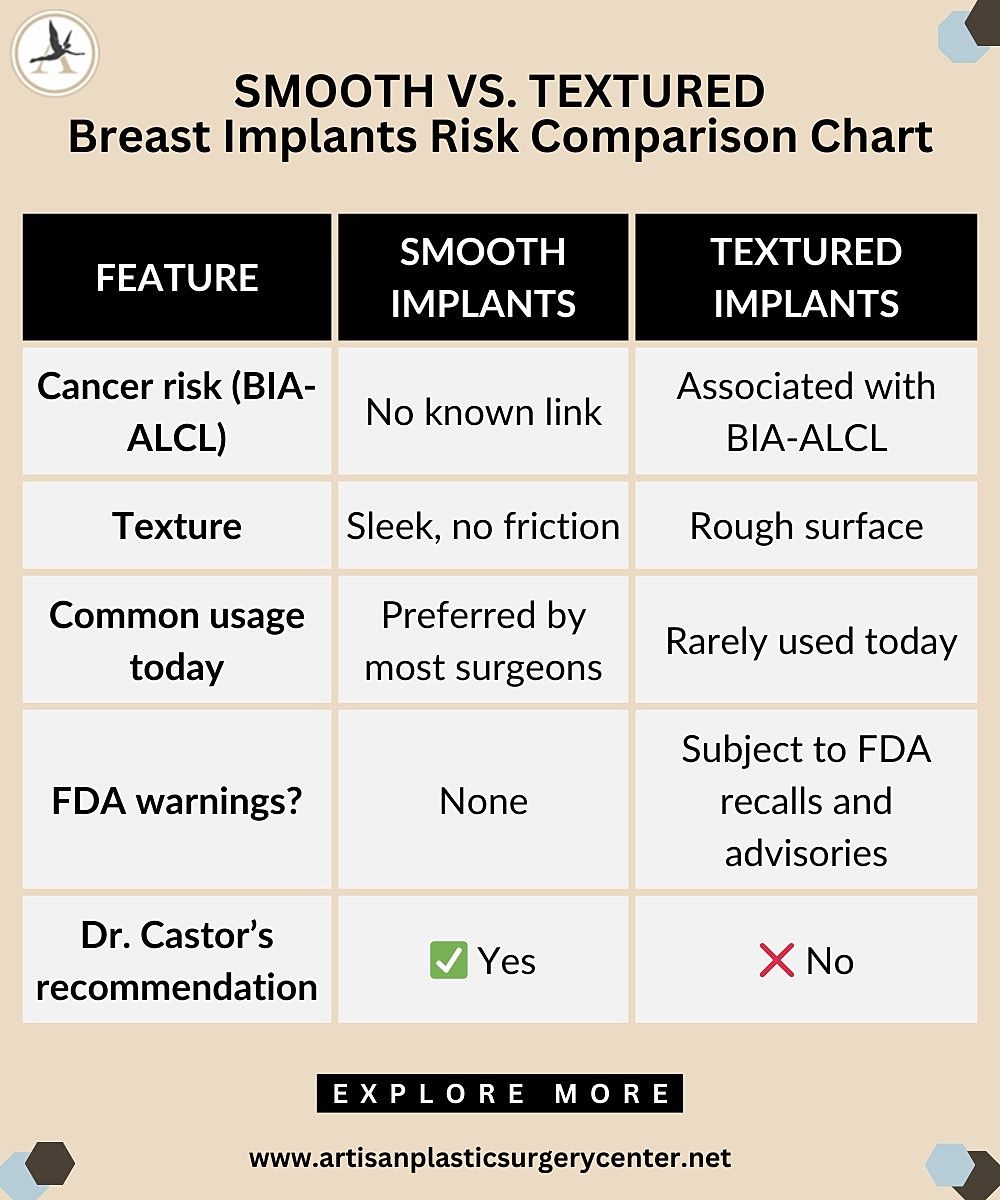
It’s an honest question, and one that deserves a clear and compassionate answer. As someone who’s been practicing plastic surgery for over two decades, I’ve walked many women through this concern. My job isn’t just to operate. It’s to educate, reassure, and make sure each woman leaves my office feeling confident about her decision.
I remember the first time I encountered a patient who was truly afraid that her implants might give her cancer. She was in her early 40s, had saline implants for about 10 years, and came to see me because she felt some tightness and swelling in her left breast. Understandably, she was anxious. She’d read online about cancers connected to implants and feared the worst.
We examined her, did an ultrasound, and later an MRI. The problem involved scar tissue tightening around the implant rather than cancer. But that encounter made me realize just how much confusion and fear exist around this topic. So let’s clear it up.
BIA-ALCL is a shortened form used to describe Breast Implant-Associated Anaplastic Large Cell Lymphoma. This term refers to a specific type of lymphoma connected to breast implants. It’s a rare type of cancer, not breast cancer, but a cancer of the immune system. It forms in the scar tissue and fluid near the implant.
Many cases have been associated with breast implants that have a rough outer surface. These types of implants were once favored for staying in place better, especially in reconstructive surgeries. But over time, we learned they might contribute to inflammation in some patients, which can lead to BIA-ALCL.
To give you perspective, the risk is very low. Depending on the type of implant and the manufacturer, the lifetime risk ranges from 1 in 2,000 to 1 in 80,000. After those discoveries, implants with textures were mostly removed from the United States market.
If you’ve had textured implants or any implants, really, here’s what to look for:
These symptoms usually appear years after implantation. On average, between 8 to 10 years post-surgery. If you notice anything out of the ordinary, come in. We’ll do an ultrasound or MRI, and if there’s fluid, we can send it for testing.
Fortunately, BIA-ALCL is highly treatable when caught early. Typically, taking out the implant along with the enclosing scar tissue proves sufficient. Some rare cases may require additional treatment, like chemotherapy, but this isn’t common.
I’ve seen one case of suspected BIA-ALCL in my career. The patient had textured implants from another provider, and she came to me with swelling and discomfort. We removed the implants and the surrounding tissue. Biopsies came back negative for cancer, but it reminded both of us how important vigilance is.
This is another valid concern. Breast implants can sometimes make mammogram examinations slightly more difficult. This is particularly true if the surgeon positioned the implants above the chest muscle. That’s why I recommend that women tell their radiologist they have implants. Surgeons use special techniques during imaging to see around the implant.
Also, I often place implants under the muscle, which allows for better breast tissue visibility during mammograms. Most radiology centers today are experienced in screening women with implants, and it’s very safe.
I also get asked about Breast Implant Illness, or BII. It’s not an official medical diagnosis, but many women report symptoms like fatigue, brain fog, muscle aches, and mood swings, which they believe are linked to their implants.
While there isn’t enough scientific evidence to define or explain BII yet, I listen to my patients. If a woman feels strongly that her implants are affecting her health, I respect her decision to remove them. I’ve performed many explant surgeries for this reason, and some patients do report feeling better afterward. That alone makes it worth discussing.
Today, I use smooth, round implants for most of my patients. These are the safest and most popular options. They move naturally with the body, have a soft feel, and, most importantly, and not linked to BIA-ALCL.
When I help a patient choose her implants, we look at everything: her anatomy, her goals, and her lifestyle. My job is to make sure she not only looks great but also stays healthy in the long run.
Certainly, some women only need volume restored. Others have sagging, especially after pregnancy or weight loss. In these cases, a breast lift (mastopexy) combined with augmentation offers the best result. I always explain this during the consultation. Implants add fullness; lifts reshape and elevate.
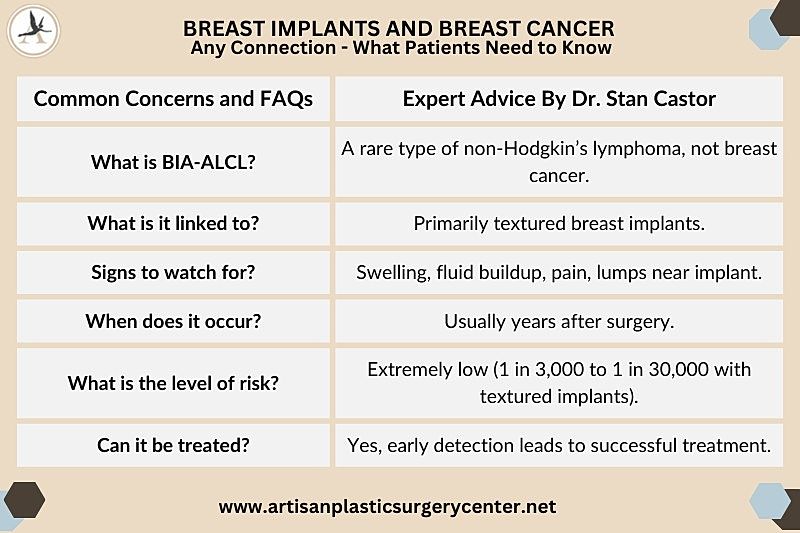
No, breast augmentation does not cause breast cancer. Extensive studies have shown no direct link between breast implants and the development of breast cancer. However, a rare type of lymphoma, BIA-ALCL, has been associated with textured breast implants.
BIA-ALCL represents a rare form of cancer impacting the immune system. This condition can manifest within the scar tissue and fluid encircling a breast implant. However, it is crucial to note that BIA-ALCL is not classified as breast cancer but rather a specific type of non-Hodgkin lymphoma. Most cases have been associated with textured implants.
While breast implants do not cause breast cancer, it’s essential to be vigilant. Inform us if you perceive any unusual circumstances. Signs to watch for include:
If diagnosed with breast cancer or BIA-ALCL, treatment typically involves:
The risk of developing BIA-ALCL is low. Women with textured breast implants face a lifetime risk ranging between 1 in 2207 and 1 in 86,029 of developing a rare cancer. Smooth breast implants do not have a significant connection to this type of cancer. The connection between the two is insignificant.
Breast implants do not reduce or increase the risk of developing breast cancer. However, they can interfere with mammogram readings, potentially delaying cancer detection. Notify the radiologist regarding any implants you have before undergoing a screening procedure.
New research indicates that smooth breast implants have a significantly weaker connection to BIA-ALCL compared to textured implants. Choosing smooth implants may reduce the already low risk of developing this rare lymphoma.
Not necessarily. While implants can restore volume, they do not address sagging skin. The surgeon may suggest a breast lift (mastopexy) along with breast augmentation to attain the preferred shape and positioning.
There is currently no evidence to suggest that breast implants increase the risk of developing breast cancer.
There is no conclusive evidence to suggest that either type of breast implant is more likely to cause cancer.
Breast implants can make it more challenging to detect breast cancer during a mammogram. But surgeons use additional imaging techniques to ensure accurate results.
There is no evidence to suggest that breast implants influence the risk of developing other types of cancer.
Breast reconstruction with implants can be a safe and effective option for cancer survivors seeking to restore their appearance after surgery.
There is currently no scientific evidence to support the claim that breast implants cause autoimmune diseases, which then increase the risk of cancer.
Healthcare providers recommend maintaining a healthy lifestyle, regular exercise. As well as avoiding smoking for all individuals, regardless of breast implant status, to reduce cancer risk.
Breast implants do not interfere with genetic testing for breast cancer risk, and results are generally accurate.
Women with breast implants should monitor for changes in the shape, size, or texture of the breast, as well as any unusual lumps or pain, and report any concerns to their healthcare provider.
There is no evidence to suggest that breast implants increase the risk of cancer metastasizing or spreading to other parts of the body.
Getting your breast implants taken out just to lower cancer risk isn’t something surgeons usually suggest. Studies show that implants don’t create a big cancer risk to begin with. The small chance of developing implant-related cancer doesn’t justify removal surgery if your implants are working fine. It’s best to focus on regular checkups and tell your surgeon about any changes you notice.
Breast implants have been linked to a rare cancer called ALCL in a small number of cases. This type of cancer affects the immune system, but it’s important to know that very few people with implants develop it. While the surgeon monitors this connection, the overall risk remains extremely small. Most people with breast implants never experience this problem and continue to have normal outcomes after their surgery.
Women who have breast implants need to get regular breast cancer screenings just like everyone else. The implants don’t change the basic screening rules. You should still get your mammograms at the recommended times and do self-checks at home. This helps them use the right techniques to get clear images of your breast tissue. Regular screenings are important for catching any problems early. Don’t skip them just because you have implants.
Scientists looked at whether breast implants could cause cancer. So far, they haven’t found any clear evidence that implants lead to cancer. They keep studying this topic to be sure. But right now, there’s no reason to think breast implants increase cancer risk. The research will continue, but current data shows no connection between implants and cancer.
Breast Implant Illness (BII) – a term used by some patients to describe a range of symptoms they attribute to their implants. Including fatigue, cognitive issues, and joint pain. BII is not officially acknowledged as a medical condition at present. This is because there is insufficient scientific proof. However, research efforts continue with the goal of gaining a better comprehension of this occurrence.
Research has proven that breast implants are safe and do not lead to cancer. Scientists have done many tests over the years to check if implants could be harmful. The results show no link between getting breast implants and developing cancer. This is good news for people who want or need implants for various reasons. Medical experts continue to monitor the safety of breast implants but have found no cancer risks so far.
If you’re considering breast implants or already have them, know this: Your health always comes first. Breast implants represent a widely researched medical device. They have undergone extensive examination and analysis. Breast implants are a common subject of study within the medical field. With modern options and experienced surgeons, the risks are low and manageable.
I’ve helped thousands of women feel more confident in their bodies. Many of them are mothers, athletes, survivors of breast cancer, or simply women who want to feel like themselves again. Each one has a story. I’m proud to be part of it. So, do breast implants cause cancer? The short answer is no. But like any medical decision, it’s important to be self-informed and choose a surgeon who will guide you every step of the way with any of the breast surgical procedures. If you have questions, concerns, or want to talk through your options.
Reach out to us at (813) 971-2000 or schedule a consultation. Let’s have that conversation. Additionally, you can browse through the breast surgery procedure photo gallery to have realistic procedure expectations.